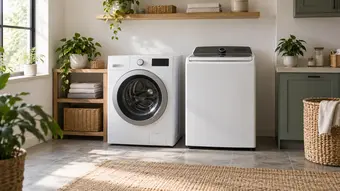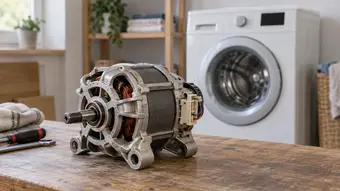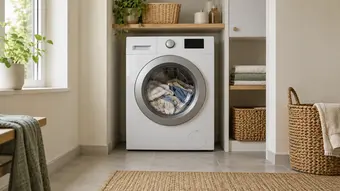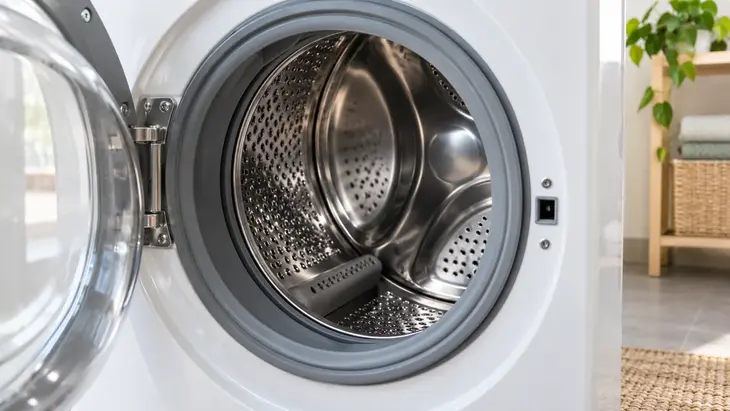
The washing machine coordinates water, movement and control to complete each phase. The drum moves the laundry, the outer tub contains the wash water, and the control system enables components to operate when the specified conditions are met.
An automatic sequence at a glance
| Phase | Main system | What it needs to coordinate |
|---|---|---|
| Preparation | Control panel and door lock | Programme accepted and access in the correct state |
| Filling | Valves and water level | Water supply suitable for the required wash |
| Washing | Motor, movement and heat where fitted | Programme action on the load |
| Rinsing | Draining and fresh water | Water discharged and fresh water added |
| Spinning | Rotation, drainage and balancing | Water removed under safe conditions |
A map of components that does not assume a single design
The Whirlpool component map distinguishes the inner drum, outer tub, valves, pump, motor and controls, and notes that heating depends on the model. Component positions are not universal.
In a horizontal-axis machine, the drum and paddles tumble the laundry; in a vertical-axis machine, an agitator or impeller is involved. The water circuit may include recirculation or gravity drainage. Water level, temperature and the door lock provide the conditions needed to progress.
The suspension supports the assembly and limits its movement, while the programmer and electronics coordinate the commands. In a semi-automatic machine, the user handles some of this coordination.
Function and diagnosis are different perspectives
Knowing what a pump does does not mean it is responsible for water remaining in the machine. Component checks need to establish what has failed, as well as identify which components are present.
Frequently Asked Questions
Are the drum and outer tub the same part?
No. The drum or inner basket holds and moves the laundry; the outer tub contains the water around it in designs that use two separate containers.
Does the pump draw water into every washing machine?
No. In many automatic machines, water enters through valves under mains pressure. The pump usually drains or recirculates water; other designs may use different arrangements.
Do all washing machines have a heating element?
No. Depending on the design, a machine may have an internal heating element, use an external hot-water supply, or wash at the available water temperature.
Can you always tell the actual water level by looking at the water?
No. Some water may be below the drum or absorbed by the load; the level is assessed by the intended control system, not just by looking through the door.
Use this map to understand how the machine operates; use the diagnostic guide when its behaviour no longer matches that operation.