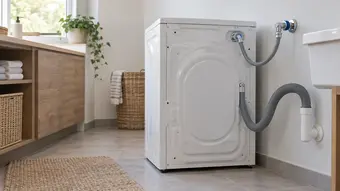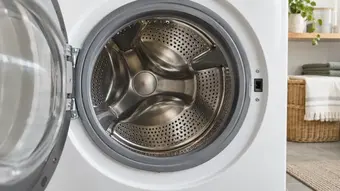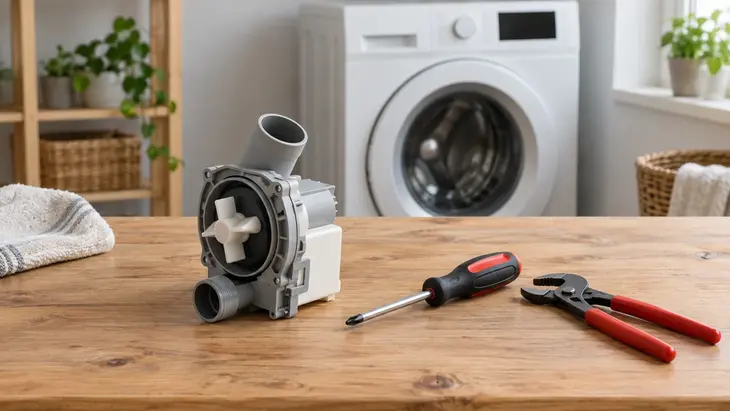
Component repair starts by confirming what has failed and which assembly is installed in the washer. The symptom guides the investigation; it does not replace identifying and checking the part.
Before choosing a replacement part
Gather the full model number, product code and revision, if available. The parts diagram can help distinguish a replaceable part from an assembly supplied only as a complete unit. Check replacement part compatibility and, for more extensive work, criteria for repairing or replacing the appliance.
Locate the subsystem
For water and sealing issues, the investigation may focus on the drain pump, water inlet valve, water level sensing, hoses or the door boot. A leak does not identify which one to choose without locating its source.
For movement issues, distinguish between the belt and pulleys, bearings, drum support, suspension and the drive system. Temperature control, the door lock and electronics each have their own procedures.
What a well-defined repair includes
- Confirmation of the cause and applicable documentation.
- Isolation of power and water, draining and preparing access with the appliance stable.
- Inspection or measurement by someone with the necessary qualifications and tools.
- Reconnecting connectors and restoring fasteners, seals and guards.
- Safety, leak and function checks in accordance with the manufacturer’s instructions.
Springs, suspended weight, sharp parts and stored energy pose risks even after the appliance has been unplugged. A manual for a different model is not a reason to improvise access.
Frequently Asked Questions
Why isn’t it enough for a part to have the same shape?
Connections, electrical specifications, seals, materials or programming may differ. The applicable part number must match the product and its revision.
Which repairs require documentation for the exact model?
Measurements, disassembly and internal part replacement require identifying the model. Even an accessible part may have different fasteners or procedures across versions.
Should a part be replaced just because it fits the symptom?
No. A cause that fits the symptom is still only a hypothesis. The component and any conditions that could make it appear faulty must be checked.
Ask for the diagnosis to explain why the part has been ruled out or confirmed, and what will be checked after the repair.