
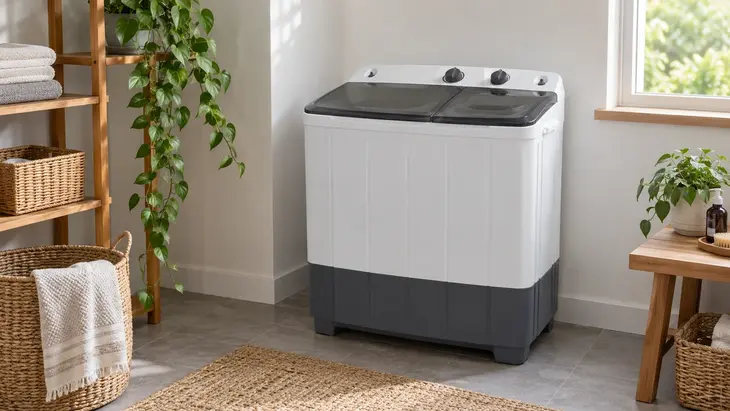
In a twin-tub machine, washing, transfer, draining, and spin drying can be controlled separately. Diagnosis should follow those operations and not assume the sequence of a front-load automatic washer.
Identify which function is failing
Check whether the appliance has separate controls and which selector controls water drainage. The manual identifies which tasks are done by the user and which are carried out by the machine.
- If washing works and the fast spin fails, see spin tub stays still.
- If the agitator does not move the clothes or acts differently than expected, use wash agitator failure.
- If it does not drain or does not hold water, identify the system in semi-automatic drainage.
- If water appears in the spin tub while the other tub is filling or draining, check tub communication.
Components and behavior that vary
There may be separate motors, timers, a basket brake, and a drain selector. Some models drain by gravity; others use a pump. The hose is not positioned at a height copied from a different type of automatic washer.
A mechanical time control is also not interpreted as an adjustable digital estimate. Observe the actual operation and avoid forcing the control or moving connections based on color.
Spin safety features
Respect the lid lock, the load-holding accessory when present, and the expected stop when opened. Never hold a switch down or put your hand inside to help the basket start.
Frequently Asked Questions
Can one tub work while the other fails?
Yes. The drives and controls can be independent. Even so, a shared power supply or drain can affect both functions.
Does a semi-automatic always use a drain pump?
No. Some designs drain by gravity and others use a pump. The selector and drain setup should be interpreted according to the appliance manual.
Should the spinner behave like the drum of an automatic washer?
Not necessarily. It may have its own time control, brake, and load distribution. Its protections and limits are not inferred from a single-drum automatic washer.
Indicate which tub still works: that separation makes it possible to guide the inspection without attributing all operations to a single motor.