
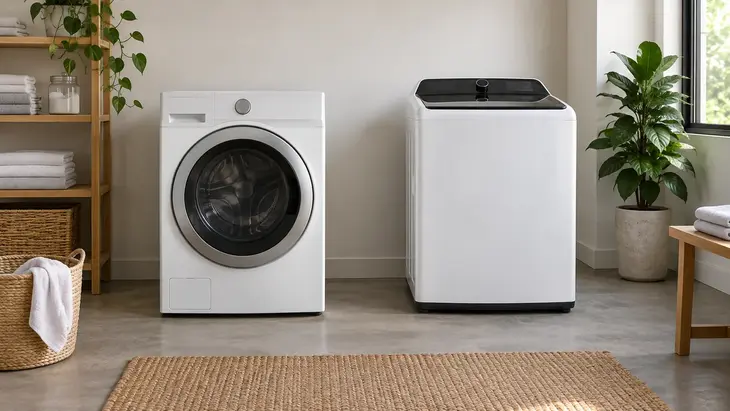
Format, mechanism, and consumption describe different aspects of a washing machine. The rating plate identifies its supply requirements; the manual specifies space, assembly, adjustments, and operating conditions.
Identification before installation
The words washing machine, washer, or washer can point to the same function, but twin tub, laundry center, and washer-dryer do not describe interchangeable equipment. The types of washing machines distinguish opening style, automation, and drying. If this is a heavy-duty laundry, the professional and industrial formats add other process and building requirements.
Find the full model, product code, and regional variant. Keep the instructions that match those details: a similar housing may conceal a different power supply, another water outlet, or a different control panel.
From available space to the first test
Check the capacities and dimensions: a figure in kilograms does not tell you how much space the open door takes up or how much room the hoses need. The installation must address support, access to connections, and drainage before powering on.
With the connections checked, the startup brings together the initial test and the adjustments the model actually offers. Calibrating, canceling a program, and resetting a connected account are different operations.
What lies behind the functions and the numbers
The washing technologies let you separate inverter motors, direct drive, sensors, and automatic dosing. The operation of the components explains why water, spin, and control must work together.
To evaluate efficiency and sustainability, compare energy per cycle, water volume, and results with equivalent program and load settings. A high nameplate power rating does not mean it is used continuously during washing.
If your question comes from a stoppage or a new noise, continue with the fault symptom. Day-to-day decisions about cycles, detergents, and garments belong to laundry use and care.
Frequently Asked Questions
Do all washing machines need the same connections?
No. The number of water inlets, electrical supply, and drainage can vary; built-in drying may add its own requirements. These must be checked on the appliance rating plate and in the manual.
Does a technology's brand name by itself tell you how it works?
No. A name can group several functions or variants. Look for which component acts, what data it uses, and in which programs it is available.
Does a higher-capacity washing machine always take up more space?
Not necessarily. Two similar exterior designs can have different usable volume, and nominal figures also depend on the declaration method.
Can labels from different markets be compared directly?
No. The scales, test programs, and consumption bases can differ. First identify the labeling system and compare equivalent measurements.
Keep the manual, the appliance identification, and the site measurements together: these are the data that connect the decisions in this section.