
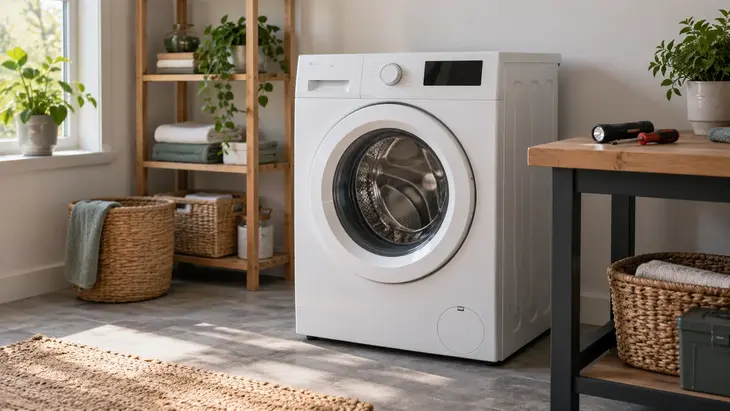
To troubleshoot a breakdown, identify what the washer was expected to do and what happens instead. The point at which the failure occurs helps more than assuming a part right away.
Start with what you can observe
A machine that holds water may prevent spinning; another may drain correctly and slow down because of the load. Although both leave clothes wet, they require different paths. Note whether the problem appears when turning on, filling, washing, draining, or speeding up.
| What is happening | Where to continue |
|---|---|
| No water enters, the level rises, or water remains trapped | Filling, water level, and drainage |
| Does not wash through motion or does not remove water from the clothes | Rotation, agitation, and spin |
| Knocks, moves, scrapes, or makes a new noise | Noises and vibrations |
| Water appears outside the machine | Leak location |
| Does not close or does not allow the clothes to be retrieved | Door, lid, and lock |
| Has no power, trips a safety device, or heats up abnormally | Electrical and thermal faults |
| The panel works, but the cycle does not start or finish | Interruptions and controls |
The design changes the diagnosis
Confirm the full model and distinguish front-load drums, top-load agitators, and machines with separate functions. Dual-tub semi-automatic machines do not always control the water level or drain with a pump. In a washer-dryer with poor drying, washing well does not guarantee that the air circuit is working.
A soak pause, a time setting, or interval filling may be part of the program. Compare the behavior with the manual. If a message appears, keep its exact wording and check the manufacturer-specific alerts.
When to stop checking
Stop using it if there are shocks, smoke, a burning smell, leaks toward connections, or violent jolts. Isolate the power from a dry, safe place; do not go near a wet outlet. Do not open panels to watch the machine while it is running. Repairing components begins after confirming the cause and the applicable part.
Frequently Asked Questions
What information should I gather before looking into a breakdown?
The full model, load type, program, and the phase where the failure occurred. Add the exact message, whether water was left inside, and what changed before the problem, such as a move or filter cleaning.
Can there be a breakdown without a code appearing?
Yes. A visible leak, a rubbing object, or a power supply fault can happen without a recorded message. The absence of a code does not confirm that the appliance can keep being used.
Does the same symptom always point to the same defective part?
No. Wet clothes can be related to draining, spin selection, or imbalance, among other conditions. The part should be identified through checks compatible with the model.
Which checks depend on the type of washer?
Filter access, emergency release, manual rotation, and the way it drains vary by design. The operations that require the door or lid to be recognized as closed also vary.
Keep your observations before clearing alerts: the phase reached, load, visible water, and recent changes let you continue the diagnosis with fewer guesses.