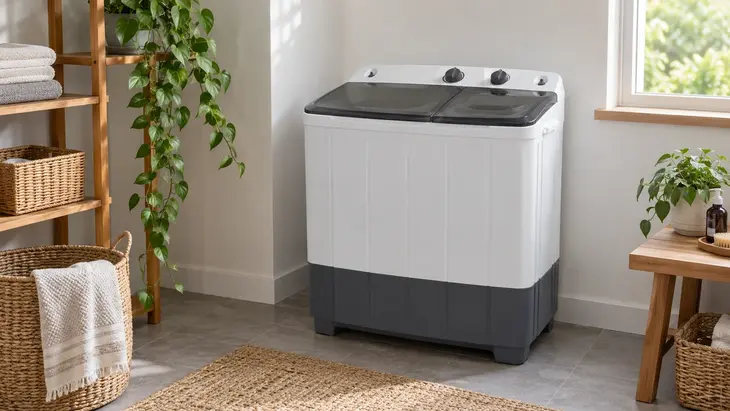
In a double-tub washer, washing, transferring, draining and spinning can be controlled separately. Troubleshooting should follow these operations rather than assume the sequence used by a front-load automatic washer.
Identify which function is failing
Check whether the appliance has separate controls and which selector controls the water outlet. The manual explains which tasks the user performs and which the machine handles.
- If washing works but the spin cycle does not, see spin tub not turning.
- If the wash plate does not move the clothes or behaves differently than expected, see wash pulsator failure.
- If it will not drain or retain water, identify the system under semi-automatic washer drainage.
- If water appears in the spin tub while the other tub is filling or draining, check water transfer between tubs.
Components and operation that can vary
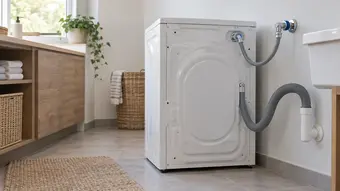
There may be separate motors, timers, a basket brake and a drain selector. Some models drain by gravity; others use a pump. Do not position the hose at a height specified for a different automatic washer.
A mechanical timer control should not be treated as an adjustable digital estimate, either. Observe the actual operation, and do not force the control or move connections based on their colour.
Spin-cycle safety features
Follow the lid-lock requirements, use the load-securing accessory if provided, and allow the washer to stop as designed when opened. Never hold down a switch or put your hand in to help start the basket.
Frequently Asked Questions
Can one tub work while the other one fails?
Yes. The drives and controls may be independent. However, a shared water supply or drainage system can affect both functions.
Does a semi-automatic washer always use a drain pump?
No. Some models drain by gravity, while others use a pump. Check the appliance manual to understand the selector and drain installation.
Should the spin tub work like the drum in an automatic washer?
Not necessarily. It may have its own timer control, brake and load-balancing requirements. Its safety features and limits cannot be inferred from those of a single-drum automatic washer.
Note which tub is still working: separating the functions helps guide the inspection without attributing every operation to a single motor.