
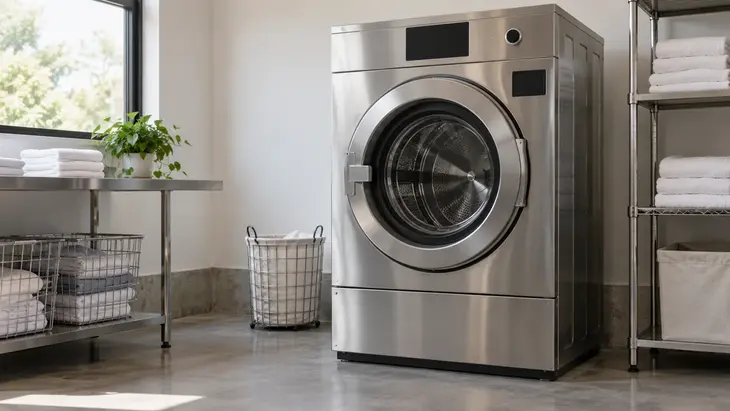
A professional washer is defined by the work and installation conditions it supports, not just by load weight. Batch processing, installation, and zone separation create different requirements.
Capacity, usage intensity, and process
Batch capacity expresses how much is processed in one load. Hourly output also depends on cycle length, loading and unloading, program changes, and coordination with extraction and drying. A large household machine does not gain an industrial duty cycle just because it has a large drum.
The terms commercial and semi-industrial are not universal technical categories. The intended use, utilities, dosing control, drainage, and maintenance documented by the manufacturer must be checked.
Families that solve different needs
- The extractor washer washes, rinses, and spins each batch in the same machine.
- The rigid or suspended mounting changes how operating forces are transferred to the building.
- The barrier washer separates the soiled-clothing access side from the clean unloading side.
- The batch continuous tunnel moves loads through modules in a coordinated line.
These features can be combined: an extractor can also include a barrier. The terminology for the format does not replace the installation specifications.
Interfaces that must be documented
It includes electrical requirements, water, internal heating or external thermal supply, drainage, compatible chemicals, and loads on the supporting structure. Operation also requires service access and loading or unloading equipment when the weight calls for it.
A physical barrier or a configurable program does not, by itself, validate a hygienic process. Decontamination parameters belong to the documented procedure for the environment and the textile, not to an expanded household recipe.
Frequently Asked Questions
Does a large-capacity household washer equal an industrial one?
No. Capacity does not prove duty cycle, interfaces, mounting, or authorized professional use. The manufacturer’s classification and documentation must be checked.
Does water extraction replace thermal drying?
No. Spin extraction removes part of the water; thermal drying evaporates the remaining moisture and is a separate stage.
Do all professional machines need to be anchored to the floor?
Not all of them use the same mounting. There are rigid and suspended designs with different requirements; even equipment without conventional anchoring still needs compatible flooring and support.
Does a physical barrier guarantee disinfection on its own?
No. Zone separation prevents certain crossovers, but disinfection depends on a validated process and on the subsequent handling of the textiles.
First define the process and its effective capacity; then verify which machine and installation are documented to perform it.