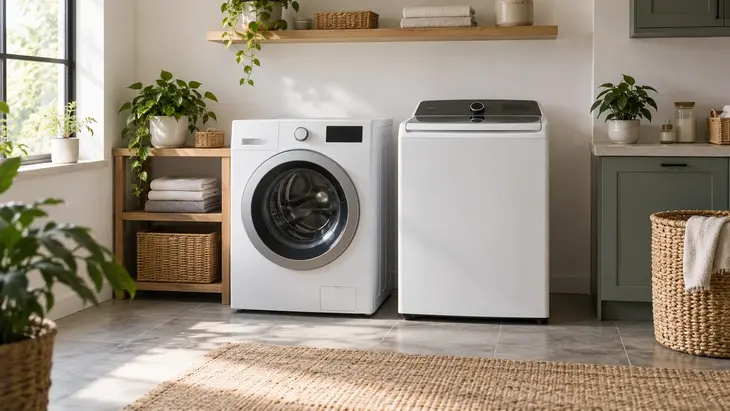
A washing machine can be front-load, automatic, compact and a washer-dryer all at once. These categories describe different dimensions; identifying them helps you avoid inferring how it works from a single word.
What each category describes
| Dimension | What to look for | Practical implication |
|---|---|---|
| Opening | Front door or top lid | Space and posture for loading |
| Movement | Horizontal drum, agitator or vertical impeller | How the clothes move |
| Automation | Automatic sequence or intervention between stages | Whether clothes need to be moved or water managed |
| Functions | Washing, spinning or heat drying | The state of the load when the cycle ends |
| Installation | Fixed, integrated, portable or modular | Required connections and access |
Distinctions that change how the appliance is understood
A top-load washer can provide access to a vertical basket or a horizontal drum. In a vertical basket, agitators and impellers create movement in different ways; neither design alone proves that the appliance has a particular energy-use certification.
A semi-automatic twin-tub washer typically separates washing and spinning, with clothes moved manually between tubs. Twin-drum systems allow two independent washes. An all-in-one washer-dryer handles washing and drying in sequence, while a laundry centre has separate compartments.
Size and installation are not the same thing
Portable describes a design intended for moving or temporary connections; compact describes smaller dimensions. For cabinetry, built-in and freestanding appliances require different documentation. A large household appliance does not become a commercial washing machine simply because of its size.
This classification identifies the design. The permitted capacity, specific connections and cleaning tasks for each type still depend on the manual.
Frequently Asked Questions
Does top-load always mean a vertical drum?
No. There are also washers with a top opening and a horizontal drum with internal flaps. Their movement and access are not the same as those of a vertical basket.
Are compact and portable the same thing?
No. A compact washer can be permanently installed; a portable one may use a temporary connection or a reservoir. Mobility and dimensions are different features.
Do twin-tub and twin-drum describe the same system?
No. A twin-tub washer typically separates washing and spinning in a semi-automatic machine; a twin-drum system may allow two independent wash loads.
Are a washer-dryer and a laundry centre equivalent?
No. An all-in-one washer-dryer uses the same drum for washing and drying. A laundry centre combines two drums in one unit.
Describe your machine by combining the categories you actually know, and leave any that need to be checked in the documentation undecided.